The AI Invisible Traveler
Introduction
You have done months of work into your website. Fresh visuals, updated itineraries, partner offers, careful SEO, all designed to avoid becoming an AI invisible traveler destination. And yet the next wave of visitors to your destination will never see any of it. Their entire trip will be imagined, optimized, and booked through an AI assistant that never once opens a browser tab with your brand on it.
This is the era of the AI invisible traveler destination. Travelers describe their dream trip in a chat window, and algorithms stitch together flights, hotels, restaurants, and hidden gems using data collected from everywhere except your owned channels. The visitor still comes. The economic impact still happens. But your DMO is almost completely invisible in their journey.
In this article we explore how that invisible planning actually works, why it disrupts traditional destination marketing, and what you can do to reach travelers you can no longer see.
The Invisible Traveler: When Trip Planning Happens Without a Single Click to Your Website
Reading time: ~11 min
- Summary
- A day in the life of the invisible traveler
- What the AI invisible traveler destination really looks like
- Why this matters for destination marketing leaders
- How destinations can reach travelers they no longer see
- Mini FAQ on the AI invisible traveler destination shift
A day in the life of the invisible traveler
Picture Mia. She lives in London, has five days off in October, and wants somewhere warm with good food and safe solo travel. Instead of opening a browser and typing a destination into a search engine, she opens her favorite AI travel assistant on her phone and writes one sentence.
“Plan a five day solo trip somewhere warm in Europe with great food and walkable neighborhoods. I like street markets, local design, and quiet boutique hotels.”
Within seconds, the assistant suggests three destinations ranked by fit. It knows her budget from past trips, recognizes that she is vegetarian from earlier restaurant searches, and guesses she prefers walkable cities because she usually books places that are close to transit.
Mia taps on one destination. The AI builds a full itinerary. It pulls reviews from booking platforms, photos from social media, menus from restaurant sites, and safety ratings from news sources and public data. It checks live weather and seasonal demand to recommend dates. It connects to airline and hotel APIs to propose bookable options directly inside the chat.
At no point does Mia search “what to do in…” or visit a DMO site. She never sees your carefully crafted neighborhood guide or your seasonal campaign. Her traveler journey is entirely AI mediated. She arrives, spends money, and leaves, and your analytics show no trace of her until maybe a stray Instagram tag appears weeks later.
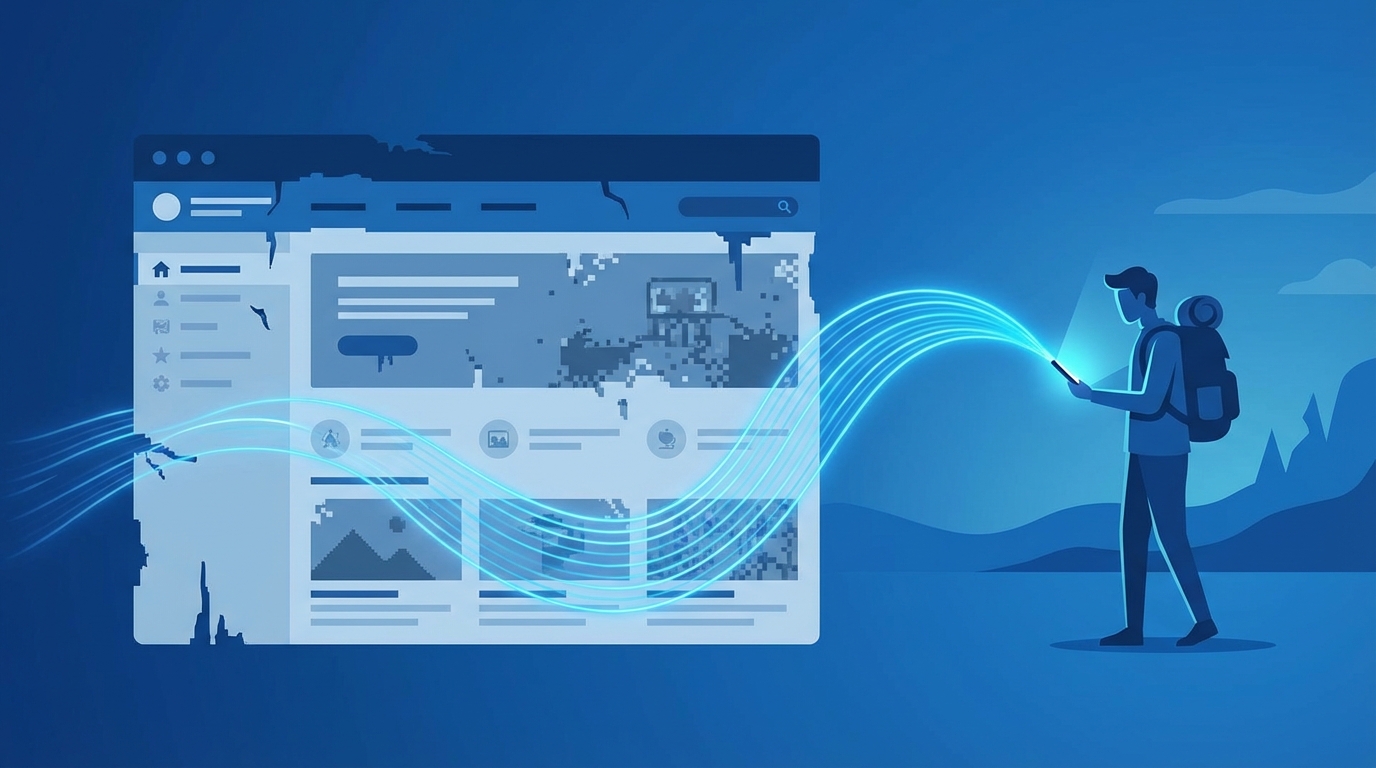
This is the invisible traveler. And for every Mia, your destination risks becoming an AI invisible traveler destination where decisions are made about you without you in the room.
What the AI invisible traveler destination really looks like
The invisible traveler is not a sci-fi story. It is the logical outcome of how modern AI trip planners work. Tools such as Mindtrip, GuideGeek, TravelAI, and general-purpose assistants like ChatGPT or Meta AI now combine several powerful mechanisms to plan trips from end to end without traditional browsing.
Data aggregation and invisible intent
AI assistants combine explicit inputs with mountains of implicit signals. Explicitly, the traveler tells the system their budget, dates, group type, and preferences such as food, activities, or mobility needs. Implicitly, the system can draw on past searches, previous bookings, device location history, content engagement, and look-alike profiles through collaborative filtering. In practice, that means the system can propose extremely tailored ideas such as “vegan friendly food tours in Lisbon with small group sizes” or “design focused boutique hotels in Tokyo near independent galleries” for travelers who never typed those phrases into a search engine.
Instead of browsing multiple DMO and partner sites, the traveler sees condensed options ranked by predicted satisfaction. The AI invisible traveler destination emerges when your content does not inform those rankings, even though your place is on the shortlist or even the final choice.
Real time adaptation without your site
Modern trip planners also update itineraries on the fly. Live data about weather, events, flight delays, or transportation disruptions feeds back into the model. The system automatically suggests indoor alternatives when rain is likely, new restaurants when one is closed, or a museum in a different neighborhood when a transit strike hits. That dynamic planning used to require visitors to check your alerts page, visitor center social feeds, or partner updates. Now it can happen entirely inside the AI assistant using third-party sources and APIs. The traveler feels supported and informed. You stay mostly invisible.
From search to chat the disappearing funnel
Historically, your marketing funnel started with intent signals in search and social. Destination campaigns, inspirational video, and high-ranking landing pages brought visitors onto your site, where you could track, nurture, and guide them. As planning shifts into conversational AI, intent signals do not vanish but they become harder for you to observe. The conversation happens in a private chat between traveler and machine. There is no referrer in your analytics, no search term for your SEO team, and fewer email sign-ups. For many DMOs, this is the core shock of the AI invisible traveler destination. The demand is still there. The funnel is still there. It is just happening somewhere you do not own or directly see.
Why this matters for destination marketing leaders
Invisible planning impacts three strategic areas. First, visibility and discovery. If 85 percent of trip planning can be completed inside AI tools with high traveler satisfaction, your classic metrics for website traffic and campaign performance will understate your real influence. A drop in sessions does not mean a drop in demand; it may simply mean that AI assistants are doing the research on behalf of your visitors.
Second, control of narrative. When AI tools aggregate data from reviews, social content, influencer videos, and third-party sites, they synthesize a story about your destination that may or may not align with your brand strategy. If your DMO has not provided structured, up-to-date, machine-readable content, the assistant will default to whatever else it can find. Outdated attractions, incomplete accessibility information, or exaggerated safety concerns can all be amplified.
Third, value to stakeholders. Many boards, hotels, and attractions still judge DMO performance by visible outcomes such as site traffic, brochure downloads, or campaign clicks. The invisible traveler challenges those legacy indicators. Your job increasingly becomes making sure AI systems recommend your destination, even if that influence never shows up as a click.
The risk is clear. In an AI-first world, a destination that does not adapt risks becoming a generic entry in an algorithmic menu while more proactive competitors shape how they are represented across assistants and trip planners.

| Strategic area | Impact in an AI invisible traveler destination context |
|---|---|
| Visibility and discovery | Website and campaign metrics capture less of the real demand as AI assistants handle more research and decision-making on behalf of travelers. |
| Control of narrative | AI tools synthesize stories about your destination from reviews, social content, and third-party data, which may not match your intended brand positioning. |
| Value to stakeholders | Boards and partners still focus on visible outcomes like clicks and downloads, even as your real impact shifts toward how often AI systems recommend your destination. |
How destinations can reach travelers they no longer see
The invisible traveler is not the end of destination marketing. It is a shift in where and how you compete. Here are practical moves every DMO should start now.
Treat AI as a new distribution channel
Instead of thinking only in terms of website visitors, think in terms of content that feeds AI systems. That includes structured data, machine-readable guides, and clear signals about neighborhoods, themes, and visitor types. When you invest in content, ask two questions. Does this help a human traveler on our site? Does this help an AI assistant make a better choice about our destination? Both matter.
If you want a deeper view of how visibility and discovery change in this environment, you can explore our work on this topic through our GEO and discovery theme on visibility and discovery.
Build an AI readiness framework for your organization
Reaching the AI invisible traveler destination is not only a content task. It touches governance, data, partnerships, and skills.
You need a clear view of
- Where AI is already influencing your traveler journey
- How mature your current data and content systems are
- Which investments will have the biggest near term impact
An AI readiness framework helps you assess your current state, prioritize actions, and measure impact on destination performance over time.
Combine human insight with AI scale
Current tools excel at efficiency yet still struggle with nuance. They can hallucinate, miss recent openings, or misjudge complex multi-country routes. That is a limitation but also an opportunity for DMOs.
You are uniquely positioned to add local expertise, cultural context, and safety insight that generic systems lack. The challenge is to express that expertise in ways both humans and machines can use. That may mean:
- Publishing clear, structured guidance on local regulations and customs
- Providing up to date alerts and seasonal recommendations in formats that machines can parse
- Using your own AI assisted research and analysis to track how your destination is represented across platforms
Educate your teams and stakeholders
Your leadership team, board, and partners need to understand the invisible traveler story. Many will still equate success with website clicks. You will need to reframe the conversation toward influence within AI systems, quality of representation, and traveler satisfaction.
Keynotes, executive briefings, and workshops on AI and destination marketing can accelerate this shift. They give everyone a shared vocabulary for discussing AI-mediated traveler journeys and help align around a practical roadmap rather than vague fear or hype. Our team regularly delivers this kind of strategic advisory and capacity building for DMOs worldwide.
Mini FAQ on the AI invisible traveler destination shift
Is the invisible traveler a niche behavior or a mainstream trend
Today it is still early but growing fast. As assistants make planning easier and more accurate, more travelers will offload research to AI. Studies already show that AI-based planning can cut manual research time almost in half while maintaining high satisfaction, which is exactly the kind of convenience that drives mainstream adoption.
Does this mean our website no longer matters
Your website still matters a lot. It remains the authoritative source for your brand, your partners, and your owned storytelling. The difference is that you now have two primary audiences: human visitors who browse and compare, and AI systems that scan, summarize, and reuse your content. The goal is to design your site so that it works powerfully for both.
How can a DMO influence what AI tools say about our destination
You cannot fully control the narrative, but you can shape it. Start by ensuring your core information is accurate, up to date, and machine readable. Monitor how major platforms describe your destination. Where you see gaps or inaccuracies, publish clearer guidance and work with partners to improve upstream data quality. Over time, strategic content, good data structure, and proactive partnerships can significantly improve how AI systems represent you.
Where should we start if we feel behind on AI
You do not need to adopt every new tool at once. Start with a focused assessment of how AI is already affecting traveler discovery, content, and distribution for your destination. From there, prioritize a small number of pilots such as structured content upgrades, internal AI training, or a governance framework for experimentation.
The invisible traveler is not truly invisible. Their choices leave traces in reviews, bookings, and economic outcomes across your destination. What changes is where those choices are made. As planning shifts into AI-powered assistants, the destinations that win will be those that understand this new interface and learn how to speak fluently to both travelers and machines.

Key takeaways for DMOs in the AI invisible traveler destination era
The rise of the AI invisible traveler destination does not eliminate your role; it relocates it. Trip discovery, comparison, and booking are increasingly mediated by assistants that never touch your owned channels, which means your influence now depends on how well you equip both humans and machines to understand your place.
DMOs that adapt their content, data, governance, and stakeholder education to this reality will be better positioned to shape how AI systems recommend their destination, even when no website click is involved. Those that do not risk becoming a background option in algorithmic menus while more proactive competitors define the story that invisible travelers see first.