AI Travel Advisor Replacing DMO
Introduction
The idea of the AI travel advisor replacing DMO content is no longer hypothetical. It is already happening in small, practical moments every day. Travelers are asking ChatGPT where to stay, using Google AI Overviews to compare destinations, and relying on itinerary builders instead of browsing ten different tourism pages.
That does not mean DMOs are irrelevant. It means your role is changing fast. The winners will not be the organizations that try to outtalk AI. They will be the ones that feed it with the most trusted, structured, and useful destination intelligence.
This is the real shift. DMOs are moving from being the visible advisor to being the source behind the advisor. If you still think your job is mainly to publish inspiring pages and wait for organic traffic, you are planning for a search model that is already breaking.
AI travel advisor replacing DMO: Is AI Becoming Your New Travel Advisor and What It Means for DMO Content Strategy
Reading time: ~12 min
Summary
- AI travel advisor replacing DMO is the wrong question
- The advisory layer is shifting from websites to answer engines
- What AI does better than traditional DMO content
- The opportunity is to become the source, not the speaker
- What DMOs need to change now
- What most professionals overlook
- A practical model for the new DMO role
- Mini FAQ
AI travel advisor replacing DMO is the wrong question

How AI is changing the discovery journey
The phrase “AI travel advisor replacing DMO” sounds dramatic, but it points to a real disruption. The mistake is assuming replacement happens only when a traveler stops visiting your website. In reality, replacement starts earlier, when AI becomes the interface through which travelers discover, compare, and narrow options.
That is already happening.
A traveler who once searched “best family weekend in Illinois” might have clicked through blog posts, event pages, and partner listings. Now that same traveler can ask a conversational tool for a two-day itinerary, hotel suggestions, rainy-day alternatives, and a dining shortlist in one prompt. The old multi-click discovery path collapses into a single answer layer.
This changes the economics of DMO visibility.
For years, many DMOs acted as destination advisors through editorial content. They inspired, informed, and guided planning. AI now performs much of that advisory layer instantly. It can summarize neighborhood differences, propose seasonal itineraries, and adapt recommendations based on budget, group type, or weather.
That breaks the old assumption that owning the website means owning the planning journey.
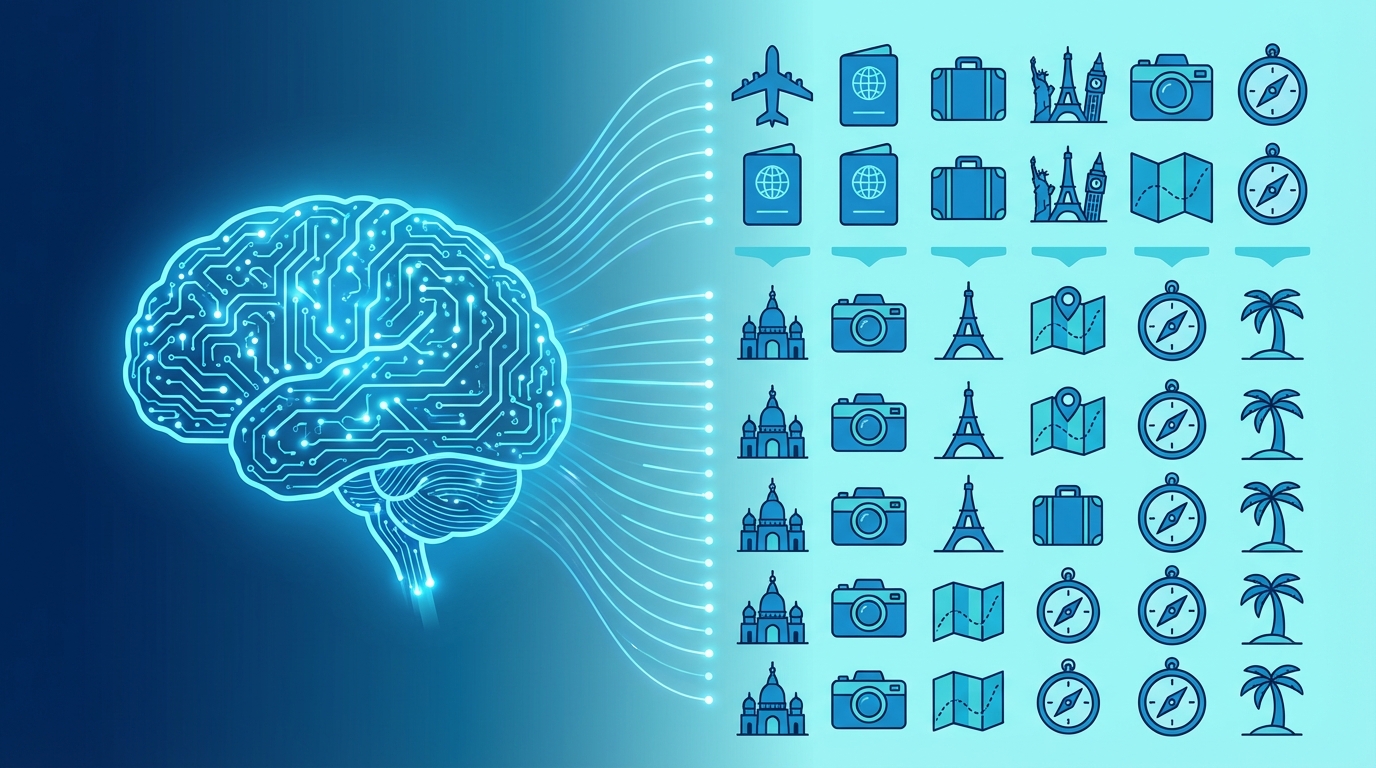
What replaces it is not a world without DMOs. It is a world where DMOs must become the most reliable source that AI systems use to generate answers.
The advisory layer is shifting from websites to answer engines
From website sessions to answer engines
The industry still talks about SEO as if ranking pages were the main game. That view is outdated.
The new battleground is answer generation. Google AI Overviews, ChatGPT, Perplexity, and embedded travel assistants are reducing the number of clicks needed to get planning help. In travel, that matters more than in many sectors because trip planning is full of comparison, ambiguity, and changing preferences. AI handles exactly that kind of messy decision making well.
This is why the advisory layer is moving away from destination websites and toward AI interfaces.
Consider a common travel behavior. A couple planning a long weekend used to search attractions, then restaurants, then hotels, then events. Now they ask one assistant for “a walkable food-focused long weekend with boutique hotels and no car needed.” If the AI can answer that credibly, your carefully written “Top 10 things to do” page may never be seen.
Many DMOs underestimate how serious this is because they still measure website sessions, campaign clicks, and page engagement as primary indicators of relevance. Those metrics matter less when influence happens upstream inside an AI response.
If you do not adapt, you will still be marketing your destination. You just will not be shaping the recommendation layer where traveler choices are increasingly made.
What AI does better than traditional DMO content
We should be honest about this. AI is already better than most DMO content at several high-value planning tasks.
It is faster at itinerary assembly. It is better at handling follow-up questions. It can personalize recommendations in real time. It can reframe the same destination for a solo traveler, a family with young kids, or a luxury couple without making the user navigate three different landing pages.
This is why tools such as destination chatbots, AI itinerary builders, and conversational trip assistants are gaining traction. Some DMOs are already testing assistants that help extend stays, surface local businesses, and answer visitor questions at scale. Others are using predictive analytics to infer traveler intent from search patterns and content consumption.
That does not mean AI replaces human expertise. It means AI replaces weak formatting, generic listicles, and static content systems.
The common industry line is that “AI enhances rather than replaces.” That is true but incomplete. AI absolutely will replace a large portion of low-value DMO content work. It will replace repetitive destination copy, broad FAQ pages, and generic inspiration content that says little and sounds like everywhere else.
If your content exists mainly to fill a website, AI will outcompete it.
If your content exists to provide verified, local, structured intelligence, AI will need it.
The opportunity is to become the source, not the speaker
This is the strategic reframing most DMOs need.
The threat is not that AI starts talking about your destination. The threat is that it talks about your destination using weak, outdated, incomplete, or commercially distorted information.
Your goal should not be to force travelers back onto your site at all costs. Your goal should be to become the source layer that AI trusts.
That requires a different content strategy.
You need content designed not only for human reading, but for machine interpretation. That means clear entity relationships, updated facts, structured event data, verified location details, seasonal nuance, accessibility information, and distinctions that generic web content usually misses.
A destination page that says “enjoy vibrant neighborhoods and world-class dining” is useless to an AI system because it contains no operational intelligence. A page that explains which neighborhood suits first-time visitors, where car-free travelers should stay, how late restaurants typically serve, and which months create crowd pressure is much more useful.
This is why DMO content strategy is converging with data strategy.

If you want to understand how visibility is changing, we recommend reading our work on GEO and AI era discovery. If you want to understand why content structure now matters as much as creativity, our analysis on data structure for destination marketing is essential.
What DMOs need to change now
Most DMO teams do not need more content volume. They need more content precision.
Shift 1 from inspiration pages to decision-grade content
The old model rewarded broad inspiration. The new model rewards usable specificity.
Travelers still want inspiration, but AI can generate inspiration instantly. What it cannot reliably invent is precise, destination-verified context. That is your advantage.
Decision-grade content includes practical distinctions such as who an area is best for, when an experience is worth the detour, what changes by season, and what a traveler should avoid assuming.
If DMOs do not adapt, AI will fill the gap with blended averages scraped from reviews, publisher content, and outdated articles. That leads to generic recommendations and weaker destination differentiation.
Shift 2 from keyword targeting to answer readiness
Many teams are still producing content around keyword phrases alone. That is too narrow.
The real question is whether your content is answer ready. Can an AI system extract a trusted answer from it? Can it understand location relationships, traveler fit, event timing, and itinerary logic?
This is bigger than classic SEO. It is about how your destination appears inside generated answers, not only in blue links.
If DMOs do not adapt, they may keep publishing content that ranks occasionally but never gets cited, synthesized, or surfaced in AI-mediated planning journeys.
Shift 3 from campaigns to continuously updated destination intelligence
Campaign thinking dominates destination marketing, but AI systems reward freshness and consistency. Events, openings, closures, seasonality, mobility constraints, and local sentiment shift constantly.
That means destination intelligence must be maintained, not merely published.
One overlooked insight is this. In an AI-mediated environment, stale information is not just a quality issue. It becomes a reputational risk. If a traveler gets a confident but inaccurate answer sourced from your outdated content, trust in the destination erodes before arrival.
If DMOs do not adapt, they risk becoming invisible when current information matters most and blamed when bad information spreads.
Shift 4 from pageviews to influence metrics
A lot of DMO reporting still centers on traffic. That is becoming less useful.
If AI summarizes your content without sending a click, your pageview disappears but your influence may still exist. The smarter question is whether your destination data shaped consideration, itinerary formation, partner discovery, and booking intent.
This is where predictive analytics, sentiment analysis, and content attribution need to mature. Some organizations are already using AI to identify traveler intent earlier and connect content performance to downstream outcomes rather than just visits.
If DMOs do not adapt, they will keep defending budgets with metrics that describe declining channels instead of growing influence.
What most professionals overlook
Here is the point many professionals miss. AI does not just compress search. It compresses destination differentiation.
When multiple destinations offer similar attractions, AI tends to summarize them into interchangeable categories unless one destination provides sharper, richer, and more structured signals. In other words, AI can flatten your brand faster than a bad campaign ever could.
That is why vague brand storytelling is becoming less effective. Not because story is unimportant, but because unstructured story is hard for machines to retain and reuse accurately.
DMOs need to encode distinctiveness in factual, retrievable forms. Not only “authentic culture” but what that actually means in neighborhoods, events, local rituals, cuisine patterns, visitor routes, and seasonal behavior.
This is where branding and content operations now intersect. Our broader research across branding and content and the future of travel explores this in more depth.
A practical model for the new DMO role
The strongest model is not human versus AI. It is human expertise expressed through AI-ready systems.
A useful way to think about the future role of the DMO is this:
| Old role | New role |
|---|---|
| Publisher of destination pages | Source of verified destination intelligence |
| Owner of top of funnel website traffic | Influencer of AI generated discovery |
| Creator of broad inspiration content | Maintainer of structured, decision grade content |
| Campaign led storyteller | Operational guide to changing destination realities |
This is also where AI can genuinely help your team. It can summarize partner inputs, identify content gaps, support segmentation, surface traveler questions, and help teams reclaim time from repetitive work. Some organizations are already formalizing this with internal AI leadership, experimentation programs, and readiness frameworks.
The point is not to install a chatbot and declare victory. The point is to redesign your content operation around how discovery now works.
Mini FAQ
Is AI replacing DMOs completely
No. It is replacing parts of the advisory experience that DMOs used to control directly. The strategic role of the DMO becomes even more important if you act as the trusted source behind AI answers.
Should we focus less on the website
Not less on the website, but less on the website as the only endpoint that matters. Your site should function as a structured source of truth, not just a digital brochure.
What content should we prioritize first
Start with high intent, high ambiguity content. Neighborhood guides, itinerary logic, seasonal planning, event data, accessibility details, and audience-specific recommendation frameworks.
Does human expertise still matter
More than ever. But it must be operationalized. Local knowledge trapped in staff heads or scattered PDFs does not help if AI systems cannot access or interpret it.
Conclusion
The hard truth is simple. The AI travel advisor replacing DMO visibility is already reshaping destination discovery, whether we like the phrase or not. The organizations that win will stop treating AI as a content gimmick and start treating it as a distribution reality. Your task is not to compete with the advisor interface. It is to become the source that makes that interface accurate, distinctive, and useful. If you want to map what that looks like in practice, explore our research, frameworks, and advisory work on DestinationMarketing.ai.